In my early years in Marathon, our family lived in a trailer park at the far southern edge of town. There were four of us in a space just thirty-three feet long and eight feet wide. It was not large, but it was home. And it sat only a stone’s throw from Pebble Beach, a place that, over time, would become holy ground for me.
Some seven years later, we moved across town into a rowhouse shared by six families. It was a different world. We were now only three streets away from Peninsula Harbour, the pulp mill, and all the sounds that came with it. It was there, in that move, that I first came to recognize something I had sensed long before but had never been able to name.
I have always been sensitive to sound. Even as a boy, I found myself listening, wondering, asking, “What is that sound?” Yet what I noticed in those early years was not quite a sound. It was more a rhythm—something I felt rather than heard. It was present when we lived in the trailer park, but it remained just beyond my understanding, like a whisper at the edge of awareness.
Living closer to the harbour changed that.
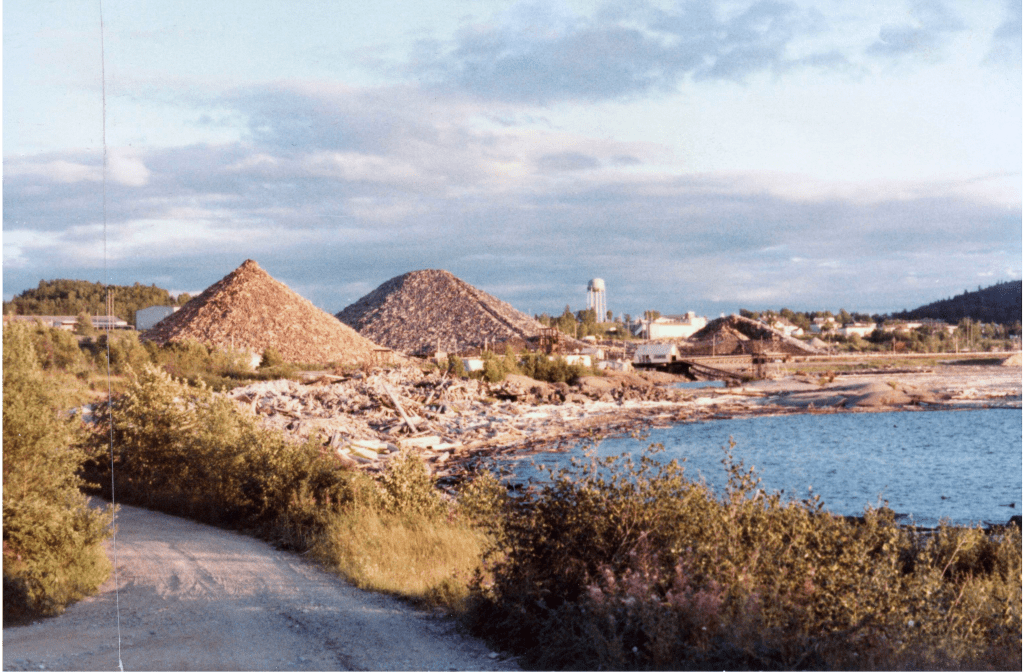
The pulp mill brought great booms of logs into Peninsula Harbour, floating in from the rivers once the ice was out in spring. From the water, the logs were drawn up onto the shore by jack ladders, chain-driven belts that dragged them upward and sorted them into five towering piles of hardwood and softwood. As the piles grew, the ladders had to be extended, and the machinery took on a life of its own.
The chains spoke first.
Clickity-clackety, clickity-clackety.
Then came the logs.
As they slid and settled into place, they answered with their own hollow rhythm:
Thunk… thunk… thunkity-thunk… thunk-thunk.
The two sounds layered over one another until they became something more than machinery. They became a pattern, steady and sure. And somewhere in that pattern, I began to recognize something familiar.
It matched the rhythm of my own heart.
What I had once only sensed, I now understood. The town itself had a heartbeat.
Through the warmer months, as long as the harbour remained open, that rhythm continued. It became part of the fabric of life—so constant, so dependable, that one hardly noticed it unless one stopped to listen.
And then, one year, I noticed something else.
It was late November. Winter was settling in. Ice had begun to form in the harbour, and the woodyard shut down for the season. Like a bear entering hibernation, everything slowed… and then stilled.
The rhythm stopped.
No clickity-clackety.
No thunk… thunk… thunkity-thunk.
Silence.
It was in that silence that I fully understood what had been there all along. The heartbeat I had sensed as a boy, and later heard so clearly, had quieted to the point of being imperceptible. It had not disappeared entirely—it was simply at rest, waiting for spring.
And I found myself waiting too.
Waiting for the ice to break.
Waiting for the logs to return.
Waiting for the heartbeat to begin again.
Years later, the mill closed.
This time, the silence was different.
It was not the quiet of winter, with the promise of spring beneath it. It was the stillness that comes when a heart has stopped. The rhythm that had once defined the life of the town was gone.
I wept.
It felt like a death. And like any death, it needed to be mourned.
In time, much of the physical evidence of the mill disappeared. Today, only the old pump house and the wharf remain—silent witnesses to what once was. To someone new, it might seem as though nothing had ever stood there at all.
But I remember.
I remember the sound.
Clickity-clackety, clickity-clackety.
Thunk… thunk… thunkity-thunk.
And I remember how it felt to realize that I was not just hearing machinery, but listening to the life of a community made audible.
The mill’s heartbeat has faded, but another rhythm remains.
The lake.
Lake Superior has its own voice, its own enduring pulse:
the gentle lap, lap, lapping of water on the shore,
the thunder of great waves rising in a storm,
the rolling of rounded stones driven against one another by the force of the surf.
The wind moves through the birches and poplars along the shoreline, whispering in their leaves. And I remember a great pine tree that grew out of the beach, rising forty or fifty feet into the air. As a boy, I would tuck my dog, Pal, inside my jacket and climb that tree. Together we would settle onto a platform formed by its branches, high above the ground.
There we would sit, feeling the wind on our faces, the tree swaying beneath us—bending, but never breaking.
The lake’s rhythm was always there. It did not depend on industry or season. It does not fade. It will outlast me, just as it has outlasted generations before.
And so I have come to understand that Marathon has known more than one heartbeat.
There was the heartbeat of the mill—strong, steady, and human-made.
And there is the heartbeat of the lake—ancient, enduring, and beyond us.
One has passed.
The other remains.
And if I listen carefully, I can still hear them both.


Leave a comment